
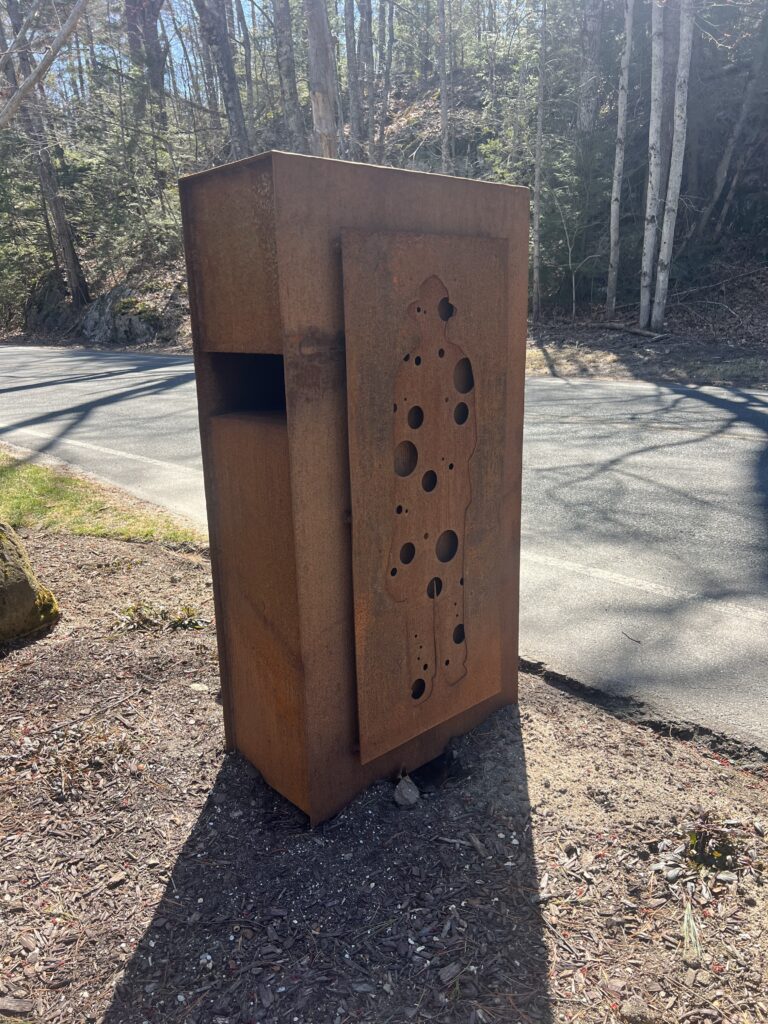
A couple of years ago, I completed a metal mailbox sculpture inspired by the work of Jonathan Borofsky. His art has had a lasting influence on how I think about scale, repetition, and the relationship between human-made objects and the spaces they occupy.
Borofsky’s sculptures often feel both monumental and approachable. There’s a clarity to his visual language—simple forms repeated with intention—that makes the work immediately readable while still carrying conceptual depth. That balance has always resonated with me. When I started thinking about this mailbox, I wasn’t interested in copying a specific piece or style outright. Instead, I focused on the underlying ideas that make his work compelling: rhythm, movement, and a sense of human presence embedded in an object.
A mailbox is an everyday object. It’s functional, familiar, and often overlooked. By treating it as a sculptural form, I wanted to elevate it without stripping away its purpose. The piece uses metal in a way that emphasizes repetition and structure, but the design decisions—proportions, fabrication methods, and finish—are rooted in my own process and aesthetic. The result is something that nods to Borofsky’s influence without borrowing his imagery or visual signatures.
That distinction matters to me. Inspiration is part of any creative practice, especially in a field like sculpture where we’re constantly responding to what came before us. But there’s an important line between learning from an artist and copying them. This project was about respect—recognizing the impact Borofsky’s work has had on contemporary sculpture, while also staying honest to my own voice as a maker.
In the end, this mailbox remains a quiet tribute. It acknowledges an artist who helped shape how I see form and repetition, while standing on its own as a functional, site-specific object. That balance—between influence and originality—is something I continue to strive for in my work.
To see my other work click here: Portfolio
Want to see the build process, check out this video.